Usługi
Najnowsze Realizacje
Najnowsze wpisy
ALT

Okuma spindle service

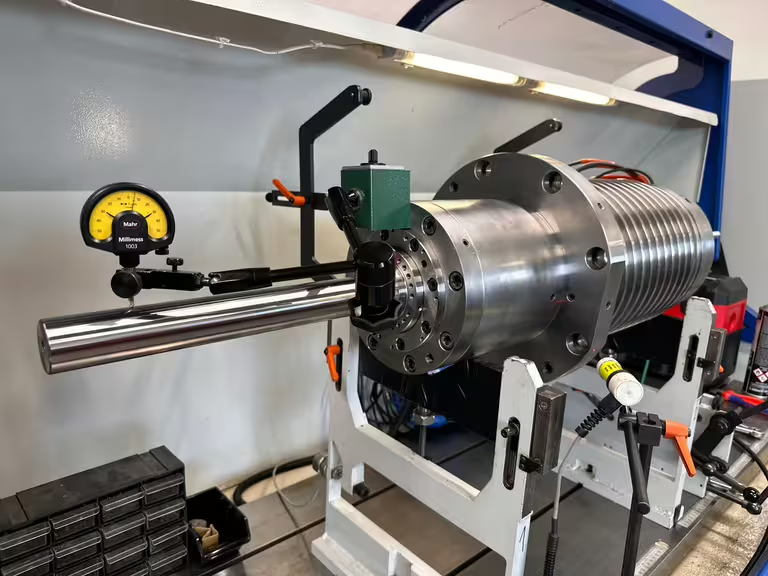
Comprehensive Okuma spindle service is a fast and reliable way to restore a spindle's full operational efficiency. We perform a full package of service procedures, including dismantling and re-mounting, bearing replacement, drawbar repair, taper restoration, cooling system and sensor maintenance, as well as testing and balancing – so that the spindle operates stably, as quietly as possible, and with high accuracy.

  • Free quote within 24 h:
    Initial assessment and scope of work
  • Urgent mode 24-48 h:
    Priority completion (if diagnosis and parts allow the matter to be closed in express mode)
  • Post-service testing:
    RMS/FFT, runout, noise, and operating temperature
  • Up to 12 months service warranty:
    Depending on the variant and scope of repair

When to order a Okuma spindle service? symptoms and consequences of continued operation without repair

Precision Spindle Service Okuma

We are not an authorized Okuma service center. The Okuma name/logo is used for informational purposes only. All rights to trademarks belong to their respective owners.

Okuma is a Japanese manufacturer of CNC machine tools, including solutions with its own spindles and electrospindles, operating on the market since 1939. The brand is primarily associated with machining centers used in woodworking, plastics, and non-ferrous metal processing. In practice, this means designs focused on stability, repeatability, and reliable operation at high speeds, where production quality and reliability are paramount.

Even a well-functioning spindle eventually loses its parameters due to operating hours, loads, and production conditions. Most often, the first signs concern bearings, the taper, or the drawbar, and sometimes problems with the measurement path (encoder/sensors) arise. In such situations, Spindle Condition Analysis is most effective – helping to quickly confirm the cause and limit the risk of fault escalation and downtime.

The most common signals that a spindle requires service:

Vibrations and drop in cutting quality

chatter, poorer finish, loss of repeatability – usually apparent in specific RPM ranges.

Overheating and signs of bearing wear

elevated temperature, increased resistance, and less stable operation during longer cycles.

Noisy operation, whistling, unusual sounds

howling during acceleration or at operating speeds – a frequent sign of bearing problems.

Weaker clamping and runout on the holder

drop in holding force, marks on the taper, tool runout – it is worth checking the drawbar and taper geometry.

Okuma spindle service step-by-step implementation stages

We carry out the service process in a logical order: first, measurements and identification of the problem source, then the actual repair, and finally acceptance testing. Such an arrangement allows us to restore operational parameters, lower vibrations, and restore predictable machining after the spindle is restarted.

Dismantling from the machine and inspection

At the start, we perform Spindle Removal and Installation. Subsequently, we carry out Spindle Condition Analysis – in this stage, we control, among others, clearances, noise, temperature, vibrations, and runout. The results quickly show whether the source of the problem is mechanics, the drive, or typical operational wear.

Replacement of worn parts and repairs

After diagnostics, we select actions that effectively remove the cause of the fault. Most often, this includes Spindle Bearing Replacement and/or Spindle Drawbar Repair, and if the problem concerns the drive section – also Electrospindle Motor Rewinding and Repair. We set the scope so that the spindle returns to stable operation, rather than just temporarily masking the symptoms.

Spindle taper grinding

If the taper is worn, overheated, or causes tool runout, we perform Spindle Taper Grinding. If minimizing downtime is critical and conditions allow, In-Machine Spindle Taper Grinding may also be possible – while maintaining the required accuracy.

Replacement of encoders, resolvers, and sensors

We verify the feedback and components responsible for speed control. If alarms, reading errors, or signal instability occur, we perform Spindle Encoder, Resolver and Sensor Replacement to restore correct control and measurement.

Spindle cooling system service

We clean the system and check its tightness and flow (air/liquid). Spindle Cooling System Service supports stable temperature, reduces the risk of overheating, and helps extend the life of bearings and seals.

Spindle balancing

After repairs, we perform Spindle Balancing to reduce vibrations and improve operational smoothness in working RPM ranges. This stage is highly significant for surface quality, cutting stability, and bearing durability.

Assembly, geometry, and clamping force

Finally, we perform Spindle Removal and Installation and settings control. If necessary, we carry out Spindle Geometry Alignment and Spindle Tool Clamping Force Measurement and Calibration to ensure the tool is guided correctly and the service result is maintained over time.

Individual services - without full service

Selected work can be realized as a pinpoint service, without a full overhaul – e.g., drive-side actions, clamping force setting, sensor and encoder service, cooling inspection, or balancing. The scope is determined after a brief symptom analysis and initial measurements.

ALT ALT
ALT

Time and logistics of Okuma spindle service how we perform the repair

Time

Most often 5-10 business days from scope approval; urgent mode possible after assessment of the fault and part availability.

Mode

We perform the service mainly at our facility (diagnostics, repair, and testing). In selected cases, we can perform some work at the customer's site.

Transport

The spindle is usually sent via courier – after securing the taper and connectors and firmly immobilizing it in the packaging. If needed, we also organize collection and delivery after service using our own transport.

Safety

Cleanliness, guard, and mount inspection, as well as checking temperature and vibration levels after service before spindle release.

Documents

Upon completion of the work, we provide a test protocol (RMS/FFT, runout, noise, temperature) and short operational tips – so that the Okuma spindle operates stably and maintains parameters for a long time in daily production.

What to send for a quote

Okuma model/type, RPM range, description of symptoms, and operating conditions – this data allows for quickly choosing the repair technology, narrowing the scope of work, and efficiently arranging the implementation logistics.

Why Okuma spindle service
affects machining quality and production stability

What delaying Okuma spindle service can cause:

  • Poorer surface and lower repeatability

    vibration marks increase on parts, finish quality deteriorates, and more corrections and reworks are needed to maintain dimensions.

  • Faster tool wear and increased machining costs

    tools lose sharpness and geometry, the risk of chipping appears, and under load, the process becomes less predictable.

  • Greater risk of secondary failures and downtime

    overheating, runout, production downtime, and costly repair of secondary damage.

A Okuma spindle with signs of wear or misalignment very quickly translates into vibrations, dimensional deviations, and poorer surface quality. When bearings lose their parameters, the taper is worn, or the drawbar does not maintain the correct force, the drive load increases and it becomes harder to maintain stable machining conditions. The best starting point to identify the source of the problem and select the correct actions is Spindle Condition Analysis.

Comprehensive Okuma spindle service combines diagnostics, mechanical/drive repair, adjustments, and final tests – thereby reducing vibrations and restoring operational parameters. Depending on the design, we perform both Spindle Service and Electrospindle Service, ensuring operational stability at high RPMs and full process repeatability.

Frequently asked questions about Okuma spindle service

Yes – we service a wide range of Okuma spindles, including air-cooled and liquid-cooled versions. Depending on the construction, we perform Spindle Service and Electrospindle Service. The final scope is confirmed after diagnostics.

Most often 5–10 business days from scope approval. The lead time may increase for electrical repairs, e.g., when Electrospindle Motor Rewinding and Repair is necessary, or when we detect additional damage requiring more extensive work.

Most often this is handled via courier – the most important is securing the taper and connectors and firmly immobilizing the spindle in the packaging. If you need, we will provide simple packing rules and help choose an insured shipment. Door-to-door service is also possible: collection, service, and safe return. If necessary, we also perform Spindle Removal and Installation so that the entire process is consistent and safe.

After initial assessment, we prepare a scope and cost estimate based on measurements. The basis is Spindle Condition Analysis (including vibrations, runout, noise, temperature) – so the quote results from diagnostics, not just a symptom description.

A full process is not always necessary. If measurements clearly confirm a single cause, we perform a pinpoint action – for example Spindle Bearing Replacement or Spindle Balancing, and when the clamp needs refinement, also Spindle Tool Clamping Force Measurement and Calibration. Such an approach makes sense when the remaining elements are in good condition.

ALT

Free Okuma spindle repair quote within 24 hours

We handle comprehensive Okuma spindle service – from diagnostics to testing and measurement reports. To prepare a quote, please send as much data as possible: spindle model/type, RPM range, and description of symptoms (vibrations/noise/overheating) – the more information, the more accurate the estimate.

  • Effect:
    Stable operation and repeatable machining quality in the working RPM range
  • Protocol:
    Measurement results after service (RMS/FFT, runout, noise, temperature)
  • Accurate diagnosis:
    Technical condition assessment and recommendations when the source of the problem is complex
  • Lead time:
    Standardly 5-10 business days, urgent mode after agreement
  • Effect:
    Stable operation and repeatable machining quality in the working RPM range
  • Protocol:
    Measurement results after service (RMS/FFT, runout, noise, temperature)
  • Accurate diagnosis:
    Technical condition assessment and recommendations when the source of the problem is complex
  • Lead time:
    Standardly 5-10 business days, urgent mode after agreement